Ever sit for a moment & find yourself overwhelmed by the object lessons around you? The falling leaves…a weed in the flower garden…a group of camouflaged birds camping in the hedges? This week has been hard, friends. Heavy. Overwhelming to the point of silence…which is why I’m sitting on my front porch & not at my desk. My brain can’t function. I’m weighed down by my personal pain & that of people I have come to dearly love… But the world hasn’t stopped so we can breathe….rude. Leaves still fall, & birds still fly. We have to force breaks just to take a breath, & the stress multiplies as we rob Peter to pay Paul from the little energy we have left. I’m exhausted, & I know I’m not alone. So, I’m on the front porch rocker, avoiding my laptop & wondering how I make the jump from staring at leaves to staring at spreadsheets… I know He is in both places, in the Excel file and in the dance of the sparrows. He is in the heartache & the hope. And He is in the present & future, just as He was in the past. He was there when we were hurt, hurting with us. Did He stop the pain? No. Why? I don’t know. He is here now, as we deal with the fallout. Does He make it easy? No. Why? I don’t know. He will be with us as we walk it out, come together, & heal thru many, many layers of hurt. Does He speed up the process? Probably not. Why? I don’t know. I don’t know why. I have ZERO answers, but if there is one thing this front-porch-sittin’ reminds me of, it’s this: He remains. I’ve sat on this rocker for 2 decades on days when I can’t handle the load. There’s something about it that puts a different perspective on the world, with the wind chimes, the critters, the leaves, & the green. He made all of this & set it perfectly into motion, even in the middle of storms. It’s peaceful when I am not at peace, & He’s met me out here several days this week. He didn’t take the pain of the process away from His own Son, so why do we feel so entitled to Him taking it away from us? He never promised that. He promised us that He would Remain. So here I am. I’m messy, guys. Broke out, sweatpants, slippers falling apart, tear-stained, angry, dehydrated–I’m MESSY. But He’s with me. He’s with all of us, & He hurts, too. He sees us in the mess & it doesn’t repel Him. He doesn’t have to come sit down beside us in the mess. He was already here, knowing this day would come.
The birds come to this porch because the hedges give them shelter. The flowers grow because the weeds get pulled, & the cat hunkers down because the birds look tasty. They all come here looking for something they know they will find, & I guess I’m no different…because here is where I’m finding Him, & I know it’s where He sustains me.
My prayer today is that if you’re hurting (& even if you’re not), that you would find altars in falling leaves & sparrows…that the mundane would become majestic in the perspective of His steadfastness…that the Holy Spirit would be a healing balm to the raw places, & that you & I, and all of us, would see His sustenance in the desert places…there is beauty even in the valleys, when we look at what He can do…
“OMG, WTH, EWWWWW!” Name something that elicits a response of “Eww, Gross!” When we discussed Feelings vs. Emotions in week 1, we learned that emotions are visceral reactions that we can’t necessarily stifle. Disgust might be one of those–ever hear this phrase?
Biologically, Disgust can actually protect us (paraphrased from Yahoo! search):
Pathogen Shield: Evolved to keep humans away from rotting food, waste, blood, and disease vectors.
Moral & Social Signal: Extends beyond physical items to reject unfairness, cruelty, or the betrayal of trust.
Sensitivity Differences: People have varying thresholds, meaning some are easily triggered while others remain unaffected.
There are a lot–a LOT–of things that can elicit the response, verbally & well, facially, of disgust. I am “disgusted” by things like stepping in dog poo, eating lima beans, touching something & getting sticky when I’m not expecting it–those are just a few things that I will lose my professionalism over, real quick-like (remind me to tell you the story about the lizard in the living room–yikes!). I think we have all experienced the feeling of being disgusted by something at one point or another (especially if you’ve had kids). Althought the emotion of being disgusted is fleeting, the feeling of disgust can actually be quite toxic & permeate many areas of our lives, throwing us into a “sin spiral” that is consequential.
Biblically, Disgust goes under a few synonyms depending on your translation. “Abomination,” “Loathing,” “Vile,” or “Odious” are found in some translations (personally, any chance I have to use the word “odious” is a win), I usually think about the book of Psalms as a great way to find “disgusting” examples of things in scripture but the truth is, it’s everywhere. We’re kind of a disgusting breed, LOL….how DOES He love us?!?!?
Physically, we learn & we know there are things that push us to that limit, & we generally avoid those things (lima beans). Spiritually, however, we sometimes become fascinated with the things we know are morally abhorrent, & we find ourselves caught in the trap of wanting to know more, and more, and more, until we realize we’re caught in a terrible web only God can free us from. It’s a very dangerous thing to let our curiosity lead us into the territory of “hath God not said?” instead of simply being satisfied with not knowing, but trusting, that God has forbidden some things in His Word.
Deuteronomy 12 discusses this with the Children of Israel (shout-out to Robert in my class who provided this example):
29 “When the Lord your God cuts off and destroys before you the nations which you are going in to dispossess, and you dispossess them and settle in their land, 30 beware that you are not lured (ensnared) into following them, after they have been destroyed before you, and that you do not inquire about their gods, saying, ‘How did these nations serve their gods, so that I too may do likewise?’
The Israelites were commanded to keep their curiosity in check, because the old proverb is right: It killed the cat. I am easily That Cat, and I have to be careful to monitor what I read and query because it sucks me in. Discussing the topic of Disgust is not intended to spiral into a competition of who can tell the worst story or give the worst example, or who is the holiest, etc. Our conversations have to balance compassion & empathy with the parameters of the Word, under the banner and protection of His love & discernment. Sometimes, that means you need to take a gentle step away from the convesation.
I personally sort-of dreaded the topic of Disgust, because I didn’t want it to lean into the drama of listing sins or issues that disgust us. My concern is that it could lead to being judgmental or arrogant; I also didn’t want to inadvertently list a sin that could lead someone into gossip or questioning the moral character of another. I find that certain topics kick off my imagination & it’s a tough time to get it corralled, so I want to tread lightly but still remain transparent. I think everyone has different areas of conviction in some areas–maybe the thought of someone scarfing down a pint of Ben & Jerry’s in a gluttonous bender is disgusting to you & you turn up your nose at it, while someone else realizes they’ve gone on that bender because they emotionally can’t process trauma &–we all have varying thresholds, & I want to be empathetic & compassionate, looking at things that cause us to be disgusted–NOT judgmental–through the lens of God’s ultimate parameters. We have to be able to be accountable to one another in love, but not in reasoning out their issue or in any kind of judgment.
A quick Google search defined biblical disgust as: *“a moral and spiritual reaction to sin, idolatry, and rebellion against God:
Divine Disgust (Abominations): God expresses revulsion toward moral corruption, false idols, and unjust behavior. InProverbs 6:16-19, the Lord specifically detests seven things, including lying tongues, hands that shed innocent blood, and sowing discord.
Human Disgust Toward Evil: Believers are called to feel a deep moral aversion to sin. Romans 12:9 instructs Christians to “abhor what is evil” and “cling to what is good.” Similarly, the Psalmist in Psalm 119:158 expresses being disgusted by the treacherous who ignore God’s word.
Physical and Ceremonial Aversion: Disgust also appears in everyday or ritual contexts, such as the foul smell of the Nile during the plagues of Egypt (Exodus 7:18) or dietary and ritual laws regarding uncleanness.
Rejection and Isolation: Prophets like Ezekiel and Nahum describe nations or people turning away from others in disgust due to judgment, ruin, or betrayal (e.g., Ezekiel 23:28, Nahum 3:7).
This blog by South Fellowship gave a great insight on one of the most frequently listed results of Disgust in the New Testament:
Revelation 3:14-16 discusses the church in Laodecea, who were complacent. They had fallen out of love with Jesus and HIs teachings, living a boring, milktoast life: These are the words of the Amen, the faithful and true witness, the ruler of God’s creation. I know your deeds, that you are neither cold nor hot. I wish you were either one or the other! So, because you are lukewarm—neither hot nor cold—I am about to spit you out of my mouth. (Revelation 3:14-16) NIV
Lukewarm water is nasty…but when you look at the culture, it’s even more of a tangible description of just how disgusting the nature of this body had become. The writer of the blog notes that the water in the city would have come from aqueducts from far away, picking up dirt, sediment, and the temperature of the Middle-Eastern countries. If you were used to it, no worries; for a visitor though, it would be gross! Nothing’s worse than thinking you’re getting a cool, refreshing gulp of water on a hot day & getting dirty, lukewarm ugh. I can’t imagine how gross it must have been & I don’t want to.
This church was surrounded by wealth & culture; the author of the blog notes they were the only one of the 7 in Revelation that were not facing persecution. Satan doesn’t bother unproductive people, so they were sitting high-&-mighty, quietly considering themselves part of the Body while embracing the corruption around them.
The warning Jesus gives the church is far more aggressive than we like to think in our modernized culture; He is literally saying He’s gonna barf these people out! I can think of nothing more offensive than serving someone & having them barf it right back up at you–He is OVER their attitudes and nonchalant treatment of His words and His sacrifice, & He is making a strong statement that it’s time to stop riding the fence. It’s a warning we need to carry in our hearts daily, to keep us burning passionately for the King! So, how do we do that? How do we avoid being disgusting to Jesus?!?
I wish this was an easy answer, & there are certainly a lot of blogs that make it out to be a 1-2-3 Easy Step version. The facts are that we are surrounded by distractions that want us to do anything but worship the Lord. From our phones to our laptops and TVs, etc, we are inundated with things that pull our attention & our eyes away from Jesus. We have to make a concentrated, daily effort to seek Jesus in who we are and what we do.
Daily time with God: This is an expected answer because it is a required discipline. You can’t ignore a garden & expect it to have an easy harvest (if any at all); maintenance has to happen. Stagnant & marriages come from a lack of communication & transparency; our relationship with Jesus is the same.
Fellowship and community with other believers: We lift each other up; we hold up each other’s arms when we’re weary. We hold one another accountable, & we build relationships based on seeing one another grow…again, with transparency and with genuine kindness and care.
Regular worship–you can’t be disgusted & lukewarm when you’re worshipping Him! If the style of music isn’t to your liking, find one that is because it’s out there!!!! And worshipping in community is a beautiful, bonding thing!
Relationship, Commitment, & Service: Building relationships through fellowship & community keeps our eyes focused on Him. Being committed to time spent with other believers is fuel for your fire! And acts of service are how we sustain the physical needs of the body while eliminating the need to outsource & support those that do not share our mission of covering the world with HIs Good News.
It’s easy to become lukewarm–all you have to do is isolate, ignore the Bible, stop talking to God, and be completely self-absorbed. Staying in a sustained on-fire relationship with Jesus takes constant awareness, discernment, and leaning on the Holy Spirit. Being passionate for Jesus doesn’t mean you’re running around with pom-pons, cheering & yelling Bible verses; being passionate for Jesus means your faith is never so mundane that those around you wonder if you’re actually a Christian. It means you’re aware of the culture but not IN the culture; it means you, however God uses you, are in the culture only so much as to CHANGE the culture.
You’re not lukewarm–you’re not getting spewed out–if you’re burning passion is to serve Jesus with your entire heart. 🙂
Let’s just rip the Band-Aid off: I struggle with Anger. The personification of Anger in Inside Out spoke to my very soul…
When McDonalds came out with the Happy Meal toys from the movie, my son hit me where it hurts: “Mommy, wouldn’t it be funny if you got your favorite one?” “Huh? Which one is that?” “ANGER! BAHAHAHAHAHAHA!!!”
OUCH.
I grew up in a family that was very, VERY expressive. It wasn’t one emotion or another; it was ALL of them, and for me, it was usually crying. I cried a LOT–I cried so much that the kids at school had a mean nickname for me that I won’t repeat, that still rings in my ear. I had/have a sensitive heart, & my mom was forever telling me to “suck it up!” Dad would beg me to “just let it roll off like water off of a duck’s back,” and I couldn’t do either.
The worst part about it, is that I have historically been an ANGRY crier. It’s not so much anymore, but as a kid, I’d be SO angry & frustrated that I couldn’t DO anything about it, that I’d cry, & it was taken as hurt or sadness. No, stupid, I’m crying because I wanna PUNCH YOU IN THE FACE and they tell me that’s wrong!!!!! (Hey, facts.) I’ve gotten better about that as an adult, mostly because I have the freedom of walking away from the situation that kids don’t generally have if we don’t allow it, but I definitely, definitely feel anger very strongly at times, and I don’t always express it in healthy ways.
I most definitely leave nothing on the table when I’m angry. If you’ve ever read anything I’ve written when I’m mad–a letter to the editor, a letter to a company, a Facebook post that’s upsetting, a text to someone that’s pushed it too far–it’s brutal. I’m very, very skilled at eviscerating someone with the written word in ways I could never do out loud (I process emotions better in writing), & it’s a terrible skill to unleash on someone. I have to seriously pray about it before hitting that “send” button, because even with that, I know there are things I’ve written that I am ashamed of (far worse than what I’ve said). Anger is an explosive thing for me that will well up and go nuclear if I don’t keep it in check…so I don’t.
When I’m angry, you know it….but my goal is to share it in a way that is respectful and balanced for as long as I can. Years of therapy have helped, but decades of being on the receiving end of someone else’s anger have actually done more to shape how I process it as an adult.
Things said in anger cannot be unsaid…I have way too many scars from the truth of that statement, & I still have things brought to mind by the Lord that He’s healing me from. I have said such things to my husband, to my family, even to my son, that I can’t take back & I struggle with forgiving myself for.
Because you EXPRESS anger, doesn’t mean that you STRUGGLE with anger. Anger is an emotion or a feeling that EVERYONE deals with. I can say that someone makes me angry– “That driver cut me off! What a jerk!”–but not ACT on it or let it ruin my day. Expressing anger doesn’t mean it’s a weight around your neck. I can be made at the bad driver. Where I cross the line, is at insulting him. Where I cross the line, is by racing up next to him, flipping him off, cutting him off, and by spending the rest of my day telling everyone how much he sucked & by letting his actions, regardless of the reason, ruin my day. Anger doesn’t have to dominate, and when we let it, there’s where we fail.
EMOTIONS DO NOT RUN US. FEELINGS DO NOT DICTATE OUR ACTIONS. WHEN WE SAY WE LOVE AND WANT TO FOLLOW JESUS, WE ARE SAYING HE RUNS US. WE ARE SAYING THAT HE AND HIS WORD, DICTATE OUR ACTIONS.
When we “pop off” or lose it, it is clear evidence that we are not listening to the Holy Spirit or speaking in love…we’re disobeying our Father.
Christians like to side-quest into discussing “righteous” anger, usually defined as anger that we have over injustice or evil. I’d like to counter it by going back to my earlier statement, that everyone has anger. Ephesians 4:26 says “be angry, but do not sin.” It’s how we act on our anger that determines whether or not it’s a problem. You can rightly be angered about someone that murdered someone, but what do you do with that anger? Do you pray about it? Ponder how that person got to that point? Do you go online and write an editorial? Do you comment on a Facebook page, or put a sign up in your front yard to protest the issue? Regardless of what made you angry, how do you handle your anger?
I like that Anger in Inside Out has a fire on his head. The Hebrew word for anger literally translates as, “His Nose Gets Hot.” It refers to how our nostrils flare when we’re mad. 🙂
Do you treat it like a flame-thrower, burning whomever comes near you, or do you put it out in the throneroom, letting Him extinguish what hurt you or upset you?
The world has a term for handling anger: “Anger Management.” It’s a funny thing in the world…They have fantastic tips for how to control, breathe thru, calm down, etc., but it doesn’t seem they give a lot of solid information to prevent or forgive. https://www.verywellmind.com/anger-management-strategies-4178870 lists simple strategies to prevent the nuclear reactions so many of us know, have encountered, or struggle with, like working out, learning to identify triggers, leaving the situation, talking it through, etc. It’s pedantic, but solid, if you can think about it in the moment.
I’d counter that though, by saying how can we live our lives in such a way that Love is so big, anger doesn’t get the chance to get a foothold?
What does anger come from? If we’re created in the image of God, does HE have anger? Why do we struggle with it in the first place? And how do we get healing from past hurts, to keep these struggles and triggers from rearing their heads?
According to VeryWellMind, there are 3 types of anger:
“Passive-AggressiveAnger: Here, a person tries to repress their anger to avoid dealing with it but typically ends up expressing it in unhealthy and undermining ways. Biblical Example: King Ahab was angry with Naboth when he wouldn’t sell him the vineyard in I Kings 21:4. He sulks, and then his wife has Naboth killed.
Assertive Anger: This can be a healthy option for expressing anger. It involves handling anger in a controlled manner by using your words to calmly explain and try to diffuse the situation. Here, anger is expressed in a non-threatening way. Biblical Example: Moses inExodus 32 sees the Israelites worshipping the golden calf. Instead of becoming violent, he pleads and intercedes with them in Exodus 32:11. Nehemiah 5 is another great example, where he finds out about the financial oppression of his people and he goes to the leadership to end it. There’s no fighting; just an integritous man, pointing out the clear violation of law with his people’s best interests at heart.
Openly Aggressive Anger: This type of anger might be accompanied by physical or verbal aggression such as screaming or hitting things. The aim of this type of anger is typically to hurt the person the anger is directed at emotionally or physically.Biblical Example: SO MANY!
Cain: Murdered his brother in anger (Genesis 4: 5-8)
Moses: Exodus 32 (later on) when the Israelites do it again, he smashes the tablets
King Saul: Got so mad at David that he tried to kill him (repeatedly)! I Samuel 18:8-11
Google: Handling anger in a biblical way involves understanding its nature and applying scriptural principles to manage it constructively.
Recognize Anger as a Normal Emotion Anger is a natural human emotion, but the Bible teaches that it should be managed wisely. Ephesians 4:26 states, “In your anger do not sin: Do not let the sun go down while you are still angry.” This emphasizes the importance of addressing anger promptly and not allowing it to fester.
Understand the Causes of Anger The Bible identifies various causes of anger, including perceived threats to personal values or injustices. Recognizing these triggers can help in managing responses effectively.
Practice Forgiveness Forgiveness is a key biblical principle. Colossians 3:13 encourages believers to forgive others as the Lord forgave them. This can help release the hold that anger has on the heart.
Seek Peace and Reconciliation Matthew 5:9 states, “Blessed are the peacemakers, for they will be called children of God.” Striving for peace and reconciliation can transform anger into constructive dialogue.
Pray for Guidance Prayer is essential in seeking strength and wisdom to handle anger. Philippians 4:6-7 encourages believers to present their requests to God, which can lead to peace that guards the heart and mind.
By applying these biblical principles, individuals can manage anger in a way that aligns with their faith and promotes inner peace.
These are the “Idiot’s Guide” to handling anger in a Biblical way…or should I say, “simpleton’s guide?” I feel like this puts an AI-generated bow on a complicated concept, because the Bible doesn’t just tell us about being angry and not sinning; it graphically lists out literal prayers sent up about all of the terrible things certain people would like to see done to their enemies in anger in several places. The most notable expressions of anger in the Bible come from what’s called the Imprecatory Psalms.: https://youtu.be/Qn9LWZPBRR4?si=srXa1u8wXxvp4sZp
These Psalms are a curse spoken to the enemies of God’s people, and they are NOT kind: “Happy is the one who seizes your infants and dashes them against the rocks” (Psalm 137:9).
“When studying the imprecatory psalms, it is important to note that these psalms were not written out of vindictiveness or a need for personal vengeance. Instead, they are prayers that keep God’s justice, sovereignty, and protection in mind. God’s people had suffered much at the hands of those who opposed them, including the Hittites, Amorites, Philistines, and Babylonians (the subject ofPsalm 137). These groups were not only enemies of Israel, but they were also enemies of God; they were degenerate and ruthless conquerors who had repeatedly tried and failed to destroy the Lord’s chosen people. In writing the imprecatory psalms, the authors sought vindication on God’s behalf as much as they sought their own…..The bottom line is that the imprecatory psalms communicate a deep yearning for justice, written from the point of view of those who had been mightily oppressed. God’s people have the promise of divine vengeance: “Will not God bring about justice for his chosen ones, who cry out to him day and night? Will he keep putting them off? I tell you, he will see that they get justice, and quickly” (Luke 18:7–8; cf.Revelation 19:2).“
These Psalms are kinda gross! But, in their defense, they were written in the midst of unjust oppression that tried the generous, long-suffering nature of the Lord. I believe they’re in the Bible to teach us that being angry and grieving, or being angry & expressing lament over such injustices, is a GOOD thing. Sharing our anger with God is a GOOD thing, as it allows us to process through His Holy Spirit, all of the feelings & emotions that He wants to hear.
We’re made in His image…so what does that mean, in the scope of anger? This quick video from The Bible Project is a beautiful explanation of the incredible long-suffering patience of our God in the face of this complicated emotion:
James 1:20 says that “man’s anger doesn’t bring about the righteous life that God desires.” Bluntly put, getting mad doesn’t bring us any closer to God & in fact, it usually puts obstacles in the way (because then we have to forgive, repent, deal with the consequences, etc.). Getting angry is a part of life & is in fact, a genuine reflection of a God Who gets angry in the face of injustice, evil, and pain. Acting on that anger instead of taking it before our Father & trusting Him to act on our behalf, only leads us to more struggles, more sadness, and more pain. Acting on our anger is a statement to God saying that we don’t need Him to fight our battles–we’ve got this–and we all know how well that goes. We have a calling and a desire to seek Him first. We have to trust in His process, in His methods of taking care of people and situations, in His way of handling it that doesn’t follow our “hot-nose” timeline of retribution.
Anger is a hot, burning flame of destruction, yet we are called to serve a God Who is Love and Who gives LIFE. Working on turning our anger over to Him will breed love and life to everyone we encounter, leading us to more peace and a closer walk with Him!
Before we tackle Joy’s “opposite” sister, I want to touch on something people forget to mention: Emotions are NOT linear. We live in a Western society that expects a lot of “either/or,” but life is more of a “both/and.” I think Eastern cultures are better at grasping these concepts and anticipating the complicated outcomes & possibilities.
I love the concept that two things can exist simultaneously while not in agreeance–we are not bound to being siloed in how we process, yet we’re thrown when we find ourselves experiencing both. We can laugh in the midst of mourning a loved one when we think about funny memories; we find ourselves scared in the midst of celebrating, etc. Why are we surprised when we find one emotion in the middle of processing another? Science actually says this is a sign our brains are functioning normally! We’re made for this!! We’re complicated beings, created by an infinitely-more complicated Being, and we cannot de-validate our emotions just because we don’t understand their complexities. They happen. Acknowledge them–God understands them so much more than we do.
“We live in a culture that loves dichotomies: happy or sad, broken or whole, mourning or dancing. We like clear lines and easy categories. But real life doesn’t work that way. Real grief doesn’t work that way. It isn’t just sorrow. It’s love. It’s longing. It’s even laughter in the midst of tears. Grief doesn’t erase joy, and joy doesn’t cancel grief. They often walk side by side, coexisting in the same fragile heart……The presence of joy does not diminish grief; rather, it honors it by allowing us to see beyond the loss—to cherish what was, even as we mourn what is no longer.“–https://www.cyndimatos.com/blog/when-grief-and-joy-collide
I’m going to add another note in here (most of this blog is directly what our small group discussed) to say that most of you, if you’ve been reading my blog for a while, know that David & I are well-acquainted with the topic of grief. Grief & sadness are often coupled together but expressed differently. I want to jump in here and say that GRIEF IS VALID. No one wearing the name tag of “Christian” has any right to say your grief isn’t valid. Jesus wept–it’s right there in John 11:35. Grief is an expression of a deep love, separated from your present state. The only reason David & I were able to progress in our journey after our daughter’s death is, and I can’t stress this enough, because we were loved well by a church body that gave us the grace to grieve our loss in transparency, while also comforting us with genuine hope. They never pretended to have the answers to “why;” they never told us to “get over it.” They held us while we wept; they wept with us. They prayed with us, and they witnessed Jesus walk with us through that valley with true kindness. It is because we have been graced with the very best of a loving church body, that we know and believe the church CAN and SHOULD be the safest place for hurting people…
Sadness is a normal human emotion defined as a state of unhappiness, sorrow, or emotional pain usually triggered by loss, disappointment, or difficult life events.
Key Characteristics of Sadness (according to a Google search & a few random resources):
• Universal Emotion: Recognized as one of the basic human emotions across all cultures.
• Physical Signs: Often shown through crying, watery eyes, lowered lip corners, or a quiet and lethargic demeanor.
• Purpose: Signals a natural need for comfort, help, or social support (that’s usually the LAST thing many of us want when we’re in the “mullygrubs,” as we say at home. Leave. Me. Alone…but you’d better hug me! But don’t touch me! ACK!–it reminds me of my very favorite Calvin & Hobbes cartoon).
• Duration: Temporary and passes with time, unlike clinical depression which is a long-lasting mental disorder (Google)
Sadness and clinical depression are different, but people often use the terms interchangeably to describe deep emotional pain.
10 common types of sadness and depressive conditions according to Google:
1. Everyday Sadness (Transient Sorrow)
• What it is: A normal, short-term emotional reaction to a difficult day, a disappointment, or hurt feelings.
• Key detail: It passes quickly and does not stop you from doing your daily tasks.
2. Grief and Bereavement
• What it is: Deep sorrow caused by the death of a loved one, the end of a relationship, or a major life loss.
• Key detail: It comes in waves and mixes with other emotions like anger or fond memories.
3. Major Depressive Disorder (Clinical Depression)
• What it is: A serious mental health condition defined by the Cleveland Clinic that causes ongoing sadness and a total loss of interest in life.
• Key detail: Symptoms last most of the day, nearly every day, for at least two weeks.
4. Persistent Depressive Disorder (Dysthymia)
• What it is: A long-term, continuous low mood that is less intense than major depression.
• Key detail: It lasts for two years or longer.
5. Seasonal Affective Disorder (SAD)
• What it is: A mood disorder that follows a seasonal pattern, usually starting in the late fall or winter when there is less sunlight.
• Key detail: Symptoms include low energy, sleeping too much, and craving carbohydrates.
6. Postpartum Depression
• What it is: Severe sadness and anxiety that happens during pregnancy or after childbirth.
• Key detail: It goes far beyond the normal “baby blues” and can make it hard to bond with the baby (my personal experience with this was life-altering; I’m forever grateful to my mom for noticing & for saving my life!).
7. Bipolar Depression
• What it is: The low-mood phase of bipolar disorder, where a person cycles between extreme highs (mania) and deep lows.
• Key detail: It is treated with mood stabilizers rather than standard antidepressants.
8. Atypical Depression
• What it is: A specific subtype of major depression where your mood can temporarily brighten in response to positive events.
• Key detail: Symptoms include heavy feelings in the arms or legs and sleeping or eating much more than usual.
9. Premenstrual Dysphoric Disorder (PMDD)
• What it is: A severe form of premenstrual syndrome (PMS) that causes extreme sadness, irritability, and anxiety in the weeks before a period.
• Key detail: Symptoms stop shortly after menstruation begins (Psychiatrists tried to say this wasn’t real a few years ago. I politely disagree…it’s horrible).
10. Situational Depression (Adjustment Disorder)
• What it is: A short-term depressive reaction to a specific, stressful life event like losing a job or going through a divorce.
• Key detail: It starts shortly after the stressful event and usually improves as you adapt.
Biblical characters who struggled with depression:
Job 3:11-26, where Job curses the day of his birth and wishes he had never been born.
Lesson: Even in deep sorrow, Job remained faithful to God, expressing his pain while continuing to seek God’s answers.
2. King David
Psalm 42:11, where David questions his soul, “Why, my soul, are you downcast?”
Lesson: David expressed his feelings honestly before God, but also reminded himself of God’s faithfulness and hope.
3. Elijah
I Kings 19:4, Elijah prayed that he might die, feeling alone and defeated.
Lesson: God didn’t condemn Elijah for his feelings but ministered to him by sending an angel to provide food, rest, and encouragement.
4. Jeremiah (The Weeping Prophet)
Jeremiah 20:14-18, where he laments his birth and the burden of his prophetic calling.
Lesson: Jeremiah’s transparency in his sorrow teaches us that it’s okay to express our emotions to God, even in moments of deep frustration.
5. Moses
Numbers 11:14-15, where Moses asks God to take his life because the burden of leading the people became too much.
Lesson: God responds to Moses’ cries, reminding him that He is always with him, and provides the support and leadership Moses needs.
6. Hannah
1 Samuel 1:10-15, where Hannah weeps and prays bitterly before the Lord, asking for a son.
Lesson: God hears our prayers, and through perseverance and faith, He answered Hannah’s cry for a child.
7. Asaph
Psalm 73:13-17, where Asaph questions whether following God is in vain.
Lesson: Asaph finds comfort when he remembers God’s faithfulness, learning that God will ultimately judge the wicked and bless the righteous.
8. Peter
Luke 22:61-62, where Peter weeps bitterly after realizing he had denied Jesus.
Lesson: Even in our worst failures, Jesus offers forgiveness and restoration, as seen when He reinstates Peter in John 21:15-19.
9. Paul
2 Corinthians 1:8-9, where Paul describes the despair he felt during a time of hardship.
Lesson: Paul learned to rely on God’s grace, acknowledging that God’s strength is made perfect in our weakness (2 Corinthians 12:9).
10. Ruth
Ruth 1:20-21, where she expresses her bitterness and grief, calling herself “Mara” (bitter).
Lesson: Ruth’s story shows us that even in the midst of sorrow and loss, God is working behind the scenes to bring restoration and hope.
11. Mary (Mother of Jesus)
John 19:25, where Mary stands near the cross, watching her son suffer.
Lesson: Mary’s faith and trust in God remained strong even during the most painful and confusing moments, showing us that faith can endure through suffering.
12. Jonah
Jonah 4:3, where Jonah expresses his desire to die, feeling displeased with God’s mercy toward Nineveh.
Lesson: Jonah’s story teaches us that God’s plans may not always align with our expectations, but His ways are always for our good and His glory.
Conclusion:
These biblical figures faced moments of depression, despair, and emotional struggle, yet their stories remind us that God understands our pain and offers compassion, healing, and hope. Through their examples, we see that it is possible to experience deep sorrow and still remain faithful, turning to God for comfort and guidance. In times of emotional distress, we can draw strength from these biblical figures, knowing that God is with us, even in our darkest moments.
Walter Brueggemann, a theologian, calls lament “the telling of all our secrets to God – the hidden, dark, painful, needy secrets that we prefer not to have or acknowledge.” This goes back to the introduction–the NEED for transparency with our Father. We cannot expect any kind of healing or progress until we’re ready to bare it all before the Lord…we have to trust that He is Who He says He is, and that He. Loves. Us.
There is joy in the journey of sadness…and sometimes, there is sadness in the journey of joy. Transparency with God, trusting that Jesus is Big Enough to carry our burdens, and allowing ourselves to meet with Him every day in that place of dependence, is what allows us to have the healing and growth He wants us to have as we walk through our valleys….
Note: Sadness and grief are a part of life, as we all know. Depression, however, is a significant state that I don’t want to ignore or gloss over. If you are dealing with prolonged sadness, fatigue, anxiety, heaviness you can’t get relief from, etc., you may be dealing with a chemical or hormonal depression that your medical professional can help you with. There is ABSOLUTELY NO SHAME in being a Christian but struggling with depression or mental health issues!!!!! We live in a broken world and have a constant barrage of chemical, natural, visual, audible, distractions and negativity flying at us nearly 24/7. Our bodies & our brains weren’t designed for the constant processing we have to do, & sometimes, we need medical/pharmaceutical/psychological help to get our minds right, so that we can get into the place where we can spiritually process and prioritize. I personally have benefitted from medical and therapeutic assistance that I am grateful for. Much like you wouldn’t try to preach to a starving man without first giving his physical body food; you can’t try to embrace joy & get healing from grief/sadness/depression without sometimes getting your physical needs met. If you or your loved one needs urgent mental healthcare, please dial 988 or visit https://www.cdc.gov/mental-health/caring/index.htmlfor more help.
In the very first post of this series, 3 looooong weeks ago, I covered an introduction breaking down that emotions are a quick, physical reaction to a situation, while feelings are more of a long-standing thing that can envelope you. The Bible says we are made in the very image of God; the One Who created us is more than capable of handling feelings and emotions that are part of Who He Is, and that He made us with! (Note: I spent 2 weeks on Joy, and spent the second half of that second week discussing Sadness, so I’m not too far behind in these posts, but I didn’t want to include my notes on Sadness and have this be stupidly long, LOL)!
The most important thing in the introduction that I want to reiterate throughout, is that God Is Able to handle our transparency, and He loves us to share with Him what He already knows according to Psalms 139:1-4
You have searched me, Lord, and you know me. 2 You know when I sit and when I rise; you perceive my thoughts from afar. 3 You discern my going out and my lying down; you are familiar with all my ways. 4 Before a word is on my tongue you, Lord, know it completely.
He absolutely knows how we feel. He has compassion, empathy, & a heart that loves us unconditionally. Encountering that love leaves us with a true desire to be 100% authentic with Him (and that transparency undoes the enemy, because that fool is the father of lies!). Transparency in sharing our hearts, emotions, feelings, desires, etc., with the Lord is a weapon that gives us deep, deep roots through the storms of life. Messy or not, we are the children of a loving Father Who never hesitates to hold us in whatever state we are in.
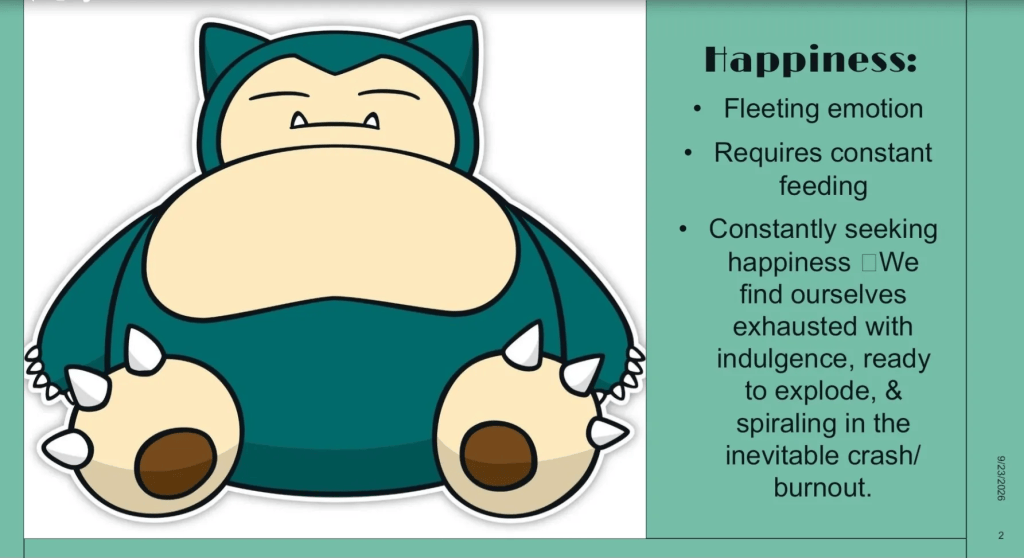
Joy is defined by the dictionary as a “feeling of great happiness.” What a crock. Happiness is a fleeting emotion that requires constant feeding. If you feed something constantly, you ultimately wind up with it exhausted with indulgence, ready to explode, & spiraling in the inevitable crash/burnout! (I love Snorlax, because he’s kind of the perfect picture of that, isn’t he?!?)
Happiness is a feeling that tends to be externally driven. It depends on situations, events, and other people aligning with your expectations. It’s future-oriented: you’ll be happy when you get the job, find the relationship, or reach the goal. Joy is more internal and less dependent on circumstances. It can exist alongside difficulty.”
Joy is a choice; it is a disciplined state that you can maintain even in the midst of pain. Joy is dependent upon the hope we have, that God is eternal and His character is unchanging! Because He remains, Joy can remain.
In the movie Inside Out, Joy & Sadness are partnered up as Sadness tries to take over & Joy feels the need to establish dominance. Joy doesn’t understand that her existence is actually made even brighter by the contrast of Sadness, not darkened when Sadness is near. Sadness and darker times solidify the truth of Joy in our lives; the desolate times make the spark of Joy have even more depth. This is impacted by our willingness to be transparent, as transparency →the acknowledgment of hard times→expressing our pain to God→Watching Him move with us, thru us, and beyond us, to sustain us & see us thru to the other side in His time.
The Psychology Today article by Dr. Jamie D. Aten, Ph.D., titled, “What is Joy and What Does it Say About Us?” features an interview with Dr. Pamela King. In the interview, she speaks about the actual science of joy, & covers 3 areas that “deeply inform joy:”
Growing in authenticity & living more into one’s strengths
Growing in deep relationships & contributing to others (this is only possible when we’re authentic with ourselves & with others. Transparency again, leads to deep roots!)
Living more aligned with one’s ethical and spiritual ideals
I love that all of the words she chose to describe growing in joy, are -ing words. They’re Being Verbs—BEEEEEEEEEEEING! Human BEEEEEEings! Joy cannot grow from a place of stasis! Stasis = Death. Think about it–nasty, stagnant water is a breeding ground for disease. Yes, it can develop its own ecosystem of decomposition, but nothing there is good. We are made in the image of God as Human BEings by a God Who’s literal Name is I AM. We. Have. To. Exist in a state of action verbs! Our lives, our successes, and our joy requires either action verbs or DEATH. It’s amazing!
So, this small group study I’m writing is titled, “All the Feels: The Facets of Feelings through the Facts of Faith.” This means I want to look at the people in the Bible who went through each emotion, and we’re discussing how they handled it, both good and bad. How can we apply these lessons and processes to our lives? Let’s take a look at a few:
Paul, while in prison & thru so many trials!
Phil. 1:3-6, 18-26
Acts 16:25-34
Mary
Mary’s Song: Luke 1:46-56
Side note: In the same chapter, Elizabeth’s son John “leaped for joy” in the womb when Elizabeth heard Mary’s greeting! Even in the womb, we know true joy, spirit-to-spirit!
David:
Bringing the Ark of the Covenant to Jerusalem: In 2 Samuel 6:14-22,
I Chronicles 29:9-16
So many Psalms! Psalm 4:7, “You have put more joy in my heart than they have when their grain and wine abound,”
I’m not going to go into each one, because my mom already says my blogs are too long. 🙂 Each of these people, however, had situations where maybe they had a reason to celebrate; maybe they didn’t. Paul was rotting in jail, but he used his time to give thanks to God and holy cow, the testimony he could share from that experience! Mary, as a young teenager, sang praise to God even though His angel just told her she was about to be an unwed mother–a death sentence in her time–and went to visit her aunt, who by all accounts shouldn’t have been able to conceive.
David–I love King David–exemplified the up-&-down journey of our spiritual walk, and by the end of it, showed a lot of transparency (good and bad) in his relationship with God. Never one to mince words; on the occasion referenced above, he was so excited about bringing the Ark back to Jerusalem that he scandalously danced in his underwear through the city (thoroughly angering his wife). His unabashed, joyful worship showed that he had no pretenses whatsoever in how he felt about the Lord….he was willing to be undignified in his joy. When was the last time you were undignified in your joy? What would that look like?
You know, I found something very interesting in working on the topic of joy…Galatians 5:22 lists Joy as a Fruit of the Holy Spirit. Love, JOY, peace, patience, kindness, goodness, faith, gentleness, and self-control…but how is Joy also a feeling, when a feeling is fleeting?
Because it’s not.
Happiness, like I said when I started this, is a feeling. Joy is a choice…a state…a fruit or a byproduct of a close walk with God by the power of the Holy Spirit. The fruits of the Spirit are stable, building us and those around us up, leading to a domino effect of positive spiritual influence, change, and productivity. Feelings, however, are impulsive, leading to undisciplined actions, behaviors, inconsistency, and never-ending self-indulgence.
99.1 Joy FM literally says, “I Choose Joy” as it’s web handle. I love that! We CHOOSE to embrace the fruits and the gifts of the Holy Spirit in our lives, even when the world is telling us to choose drama, noise, anger, etc. When we choose joy and we choose to share joy, we are pouring out a beautiful perfume to everyone that encounters us. It’s that joy that’s contagious, that makes people want to know why we’re different. He Makes Us Different!
Around 181x in the ESV, we find the word “JOY” in the Bible!
1 Thessalonians 5:16-18: “Rejoice always, pray continually, give thanks in all circumstances; for this is God’s will for you in Christ Jesus.”
Romans 12:12: “Be joyful in hope, patient in affliction, faithful in prayer.”
Psalm 94:19: “When anxiety was great within me, your consolation brought me joy.”
Psalm 95:1: “Come, let us sing for joy to the Lord; let us shout aloud to the Rock of our salvation.”
Isaiah 12:3: “With joy you will draw water from the wells of salvation.”
Romans 5:11: “Not only so, but we also glory in God through our Lord Jesus Christ, through whom we have now received reconciliation.”
Philippians 4:4: “Rejoice in the Lord always. I will say it again: Rejoice!”
Nehemiah 8:10: “The joy of the Lord is your strength.”
Joy is a place of stability for us, because we are anchored in the hope we have in Jesus. Hope is the key word–hope isn’t a fruit of the Spirit, because it is not based on interpersonal relationships. Hope, like faith, is solely dependent on Jesus & His work in our lives. Hope is between Him and us…and because we KNOW HE IS WHO HE SAYS HE IS, we can have long-standing, solid joy in Him that we share with others!
Choose joy today. Make the decision to sit at the feet of Jesus, share your heart–share the good, the bad, and the ugly–and let Him exchange it for the beauty only He can give, as He heals your hurts & exchanges the pains of this world for the Joy that can only come from Him.