Ahhhh, Embarrassment….
I feel like this guy & I are lifelong friends/frenemies. 🙂 From falling over trash cans in the middle of Disney World, to tripping over construction cones in the middle of the mall, to walking into a concrete pole while attempting to flirt (& earning my first set of stitches); Embarrassment & I go waaaaaaay back…and knowing me, we’ll continue the rest of my journey of life together. Heck, I’ll probably trip up the stairs & fall into my own casket. ADHD + all of the grace of a drunk giraffe = more stories that should have won me $25000 on America’s Funniest Home Videos than most (& A GREAT deal of gratitude that I didn’t grow up in the Digital Age!!!!).
My general lack of situational awareness has cost my parents many a sleepless night, & there are still times that I marvel I’m still alive, even in my own home. I recently nearly ended myself by slicing my own wrist while demonstrating to my son how NOT to cut a zip tie! I was mortified! But hey, at least he won’t forget it, right? (I feel like the therapy bill is coming)?!? At almost 49 years of age, I’d like to think to myself that I am almost un-embarrassable, but I know that’s not true…in fact, it’s just when I think I can shake anything off that I learn there are some things that are branded in my brain.
One of the interesting things about many ADHD’ers is that we struggle with something called “ruminating thoughts.” I’ve mentioned it recently; it basically means you’re stuck in a negative thought pattern you can’t escape from. Embarrassment, shame, and judgment are things that really get people hung up in those loops & it can be a devastating thing to be under. We replay what we should’ve-could’ve said, what we did wrong/right, & everything in-between; we can’t break the cycle & we’re convinced we’re fired/relationship is over/kids are ruined until we’re finally able to get the pattern broken. Shame in particular (& embarrassment on repeat leads to shame) is so oppressive. when I’m really off-kilter, I know I have to drown myself in worship music. It’s the only thing that can redirect me, & I’m so grateful for that freedom.
Let’s take a look at embarrassment & shame–
According to Psychology Today, Embarrassment & Shame are slightly different from one another:
- Embarrassment: Self-conscious reaction to perceived slight or failure
- Shame: Moral failure & damage to reputation
There are many biblical examples of embarrassment & shame. One that I thought of but didn’t see listed anywhere, was Jesus Himself. As He was being arrested & tried, and as He was carrying the Cross to Golgotha, I have to wonder if the taunts & mocking were worse than the physical pain itself (Luke 23)? These people He loved so much, even to the point of death, were brutalizing Him by mocking His entire reason to be on this planet. He loved us even then…He was separated from His Father for the first and only time. The weight of that sin He bore–He knew shame in that moment, like no one ever could. He carried it. He carried ALL of it (Matthew 27:45). He knew embarrassment like no one ever could…yet He didn’t hide at all. He welcomed it, for us…it’s mind-boggling. Hebrews 12:2 says, “For the joy set before him he endured the cross, scorning its shame, and sat down at the right hand of the throne of God.” He went through it all, He bore the shame, and yet did not let it define Him as He continued on to conquer death & win our salvation!!
Other examples of shame or embarrassment in the Bible include King David (Psalms 51, written after the prophet Nathan confronted him & the sin of murdering Bathsheba’s husband and sleeping with her prior to the fact); David’s wife from Saul, Michal (2 Samuel 6), who was mortified that David was dancing in his undergarments after the Ark of the Covenant was brought back to the Hebrew people (& as a punishment for her mockery, was rendered childless); Adam & Eve in Genesis 3, who were trying to hide from God in the Garden of Eden once they realized they were naked; Peter, when he denied Christ in Matthew 26; and Moses in Exodus 2, after he killed an Egyptian & realized that someone saw him.
Christians have a long-standing history with shame, using it as both a weapon and a noose. I pulled up a few resources from various Christian counseling sites that had some great points of view:
- https://christian-works.org/guilt-and-shame-a-christian-therapists-perspective/
- https://biblicalcounseling.com/resource-library/podcast-episodes/questions-on-guilt-and-shame-mailbox/
- https://www.crossway.org/articles/the-only-way-we-can-overcome-the-debilitating-power-of-shame/
Each of these sites lists examples of guilt, shame, and embarrassment, and how we as Christians wrestle with these concepts in the light of the saving freedom Jesus gives. We all know Satan is the Great Accuser–what do accusers do? They point fingers, mock, gaslight, undermine, & basically do anything they can to make someone look guilty.
Revelation 12:10 (Amp) Then I heard a loud voice in heaven, saying,
“Now the salvation, and the power, and the kingdom (dominion, reign) of our God, and the authority of His Christ have come; for the [a]accuser of our [believing] brothers and sisters has been thrown down [at last], he who accuses them and keeps bringing charges [of sinful behavior] against them before our God day and night.
It’s literally what he does–he picks & points, trashing us in every possible way, trying to crush us under the weight of our sin & shame…but then Jesus comes in, throwing him out & reminding God the Father that His sacrifice made us FREE!!!!!!!! The accusations are covered under the blood of Jesus! Woohoo!
And yet, we still struggle with shame & condemnation…So what do we do? How do we break the ruminating thoughts, the shame spiral? How do we stop obsessing over our shortcomings & focus instead on the redemption Christ offers? The resources I listed above stated that (paraphrased) Christians respond to guilt and shame by separating the two experiences—using guilt as a tool for repentance, and replacing shame with their new identity in Christ.
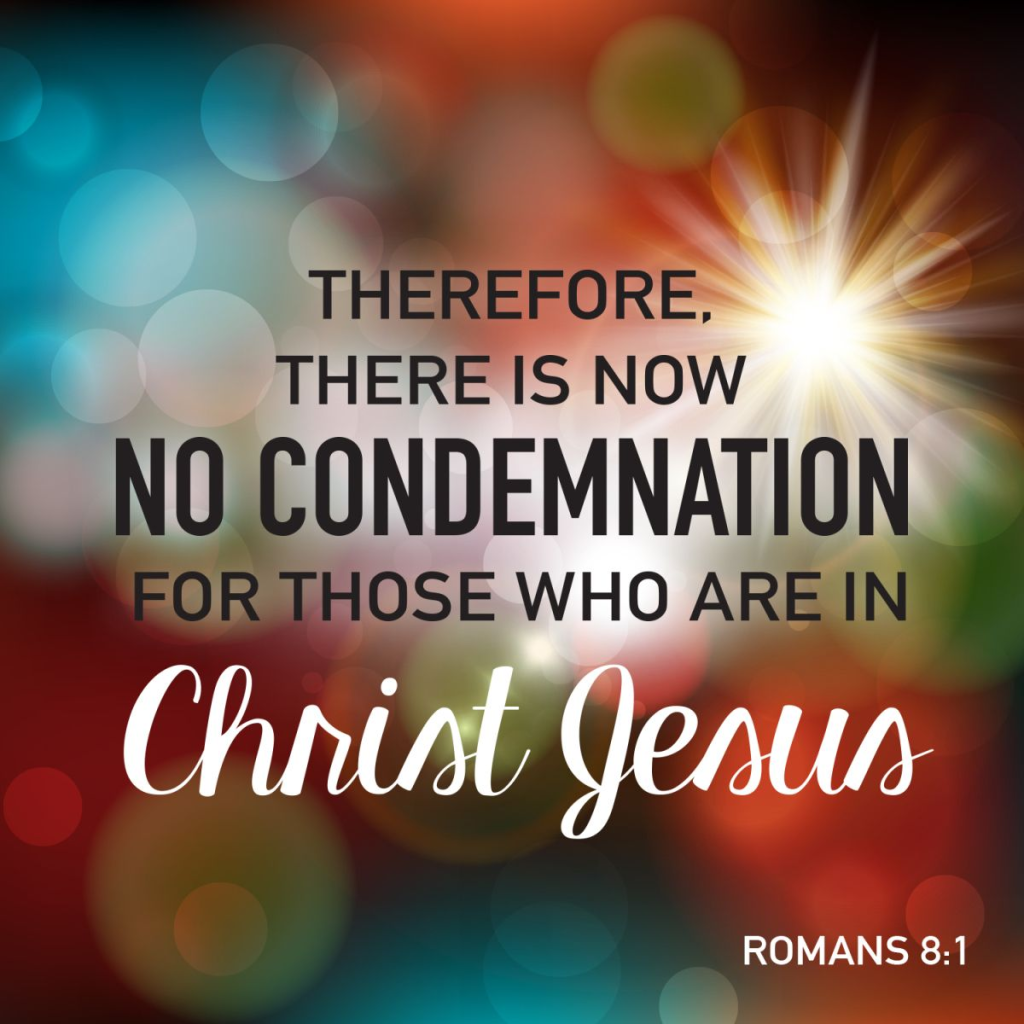
I want to remind anyone reading this that there is a big difference between “condemnation” & “conviction.” My husband once preached a sermon that revolutionized how I thought of the two concepts. “Condemnation” destroys. It means something is so awful that it has to be destroyed and completely rebuilt; it’s uninhabitable. It’s basically garbage. Romans 8:1 says “There is therefore now no condemnation for those who are in Christ Jesus.” We cannot be condemned if we love the Lord!!! When we hear that nasty old Accuser coming after us, we can respond with Joy & Freedom, because if we love Jesus, he can’t stick that “Condemned” sign on our door!
“Conviction” is different–conviction is the process by which the Holy Spirit speaks to our heart to tell us we’re in the wrong. We need to seek forgiveness & restoration; we have to bring the issue, whatever it is, before the Lord & make it right. To be convicted of a crime means a wrong has been done, guilt has been proven, and a price must be paid. Jesus paid it all, right? So no one but He has the right & ability to call us to ask forgiveness and change for the better….and how do we do that? The resources above gave the following path to responding to guilt & shame when we encounter it from wrongdoings:
1. Responding to Guilt (The “What I Did”): Guilt is a conviction over a specific action–it’s like an alarm bell that drives you back to God.
- Confess and Repent: Acknowledge the specific wrongdoing honestly to God rather than hiding or minimizing it (Psalm 32:3–5).
- Receive Forgiveness: Trust God’s explicit promise of complete cleansing and forgiveness through Jesus Christ’s sacrifice (1 John 1:9).
- Make Restitution: Where possible, apologize, repair harm, and seek reconciliation with people you have wronged (Luke 19).
- Reject False Guilt: Refuse to keep punishing yourself for sins that have already been confessed, forsaken, and covered by grace. (Tell the Accuser to bugger off!!!)
2. Responding to Shame (The “Who I Am”): Shame attacks your literal identity, telling you that you’re unlovable & defective.
- Anchor Your Identity in Christ: Shift your focus from your failures to your new status as a child of God, declaring that “there is therefore now no condemnation for those who are in Christ Jesus” (Romans 8:1)
- Bring it into the Light: Shame thrives in isolation and secrecy. Confess your struggles or hidden pain to a safe, trusted fellow believer, pastor, or community (James 5:16). ACCOUNTABILITY & TRANSPARENCY ARE CRITICAL FOR REPENTANCE & TRUE CHANGE!
- Replace Lies with Truth: Actively counter vague, shaming accusations by replacing them with scripture regarding God’s unconditional love and acceptance.
- Seek Support: Reaching out for professional Christian counseling or mental health support is not a lack of faith; it is a practical way to walk in the light and heal from deep emotional or past trauma.
Restoration:
I once went on a youth retreat where the speaker stated unforgiveness, even of ourselves, was like having a big ol’ dog that passed away. It’s there, it’s in your house, and you need to bury it & send it to Jesus….but instead, you lug that big ol’ dead dog around with you everywhere you go…rotting, stinking, driving everyone away, & imprisoning you by its very presence. Guilt, shame, & unforgiveness are chains we’re not obligated to wear. Once we’ve realized we’ve done something that requires repentance, we then need to ask forgiveness from anyone we may have hurt. This is so, so hard, and I’ve seen it go badly, even with the best of intentions. Recovery meetings may tell you that if you need to skip making amends with someone for their mental health or your safety, that’s okay. But if you can humble yourself & tell someone when you’re truly sorry for something you’ve done wrong, they can be such a blessing if they’re able to forgive you!
Forgiving ourselves can be even more difficult…it’s something I struggle with, personally. I can really get trapped in those ruminating thoughts when I’ve made a mistake or hurt someone; even if I’ve gone to them and asked forgiveness, I will still beat myself up, which is ungodly. Reaching out to pastoral leadership, therapist, or accountability partners is very helpful in learning ways to distract ourselves out of the spiral.
Forgiving others can also be freeing in its own way. My mom often reminds me to “fake it til I make it,” & she’s not wrong. Some people have been on my “To Forgive” list for YEARS…I’ll periodically tell Jesus I forgive them & turn right back around and wish they’d been hit by the beer truck. It’s an ongoing process and someday, when I say I forgive them, I’ll mean it with my whole heart because I will officially be healed of the damage they did. Until then, I’ll keep saying it and working towards believing it. 🙂
Embarrassment & Shame can come from a myriad of places, but one place they can’t go, is in the presence of God. When I’m really struggling, especially with feelings of shame & guilt, I know that getting in His Word or turning on worship music will redirect my downward spiral. Embarrassment & Shame may make us want to hide in a corner in our hoodie, but the love of Jesus & His Holy Spirit counter them with love, freedom, & forgiveness.
The love of Jesus casts out so many things…condemnation, fear, etc. I hope that when you encounter Embarrassment or Shame, that you’re able to find new ways to focus on the freedom His Love gives, as you let His forgiveness set you free!