All the Feels Week 6: Embarrassment & Shame

Ahhhh, Embarrassment….

I feel like this guy & I are lifelong friends/frenemies. 🙂 From falling over trash cans in the middle of Disney World, to tripping over construction cones in the middle of the mall, to walking into a concrete pole while attempting to flirt (& earning my first set of stitches); Embarrassment & I go waaaaaaay back…and knowing me, we’ll continue the rest of my journey of life together. Heck, I’ll probably trip up the stairs & fall into my own casket. ADHD + all of the grace of a drunk giraffe = more stories that should have won me $25000 on America’s Funniest Home Videos than most (& A GREAT deal of gratitude that I didn’t grow up in the Digital Age!!!!).

My general lack of situational awareness has cost my parents many a sleepless night, & there are still times that I marvel I’m still alive, even in my own home. I recently nearly ended myself by slicing my own wrist while demonstrating to my son how NOT to cut a zip tie! I was mortified! But hey, at least he won’t forget it, right? (I feel like the therapy bill is coming)?!? At almost 49 years of age, I’d like to think to myself that I am almost un-embarrassable, but I know that’s not true…in fact, it’s just when I think I can shake anything off that I learn there are some things that are branded in my brain.

One of the interesting things about many ADHD’ers is that we struggle with something called “ruminating thoughts.” I’ve mentioned it recently; it basically means you’re stuck in a negative thought pattern you can’t escape from. Embarrassment, shame, and judgment are things that really get people hung up in those loops & it can be a devastating thing to be under. We replay what we should’ve-could’ve said, what we did wrong/right, & everything in-between; we can’t break the cycle & we’re convinced we’re fired/relationship is over/kids are ruined until we’re finally able to get the pattern broken. Shame in particular (& embarrassment on repeat leads to shame) is so oppressive. when I’m really off-kilter, I know I have to drown myself in worship music. It’s the only thing that can redirect me, & I’m so grateful for that freedom.

Let’s take a look at embarrassment & shame–

According to Psychology Today, Embarrassment & Shame are slightly different from one another:

  • Embarrassment: Self-conscious reaction to perceived slight or failure
  • Shame: Moral failure & damage to reputation

There are many biblical examples of embarrassment & shame. One that I thought of but didn’t see listed anywhere, was Jesus Himself. As He was being arrested & tried, and as He was carrying the Cross to Golgotha, I have to wonder if the taunts & mocking were worse than the physical pain itself (Luke 23)? These people He loved so much, even to the point of death, were brutalizing Him by mocking His entire reason to be on this planet. He loved us even then…He was separated from His Father for the first and only time. The weight of that sin He bore–He knew shame in that moment, like no one ever could. He carried it. He carried ALL of it (Matthew 27:45). He knew embarrassment like no one ever could…yet He didn’t hide at all. He welcomed it, for us…it’s mind-boggling. Hebrews 12:2 says, “For the joy set before him he endured the cross, scorning its shame, and sat down at the right hand of the throne of God.” He went through it all, He bore the shame, and yet did not let it define Him as He continued on to conquer death & win our salvation!!

Other examples of shame or embarrassment in the Bible include King David (Psalms 51, written after the prophet Nathan confronted him & the sin of murdering Bathsheba’s husband and sleeping with her prior to the fact); David’s wife from Saul, Michal (2 Samuel 6), who was mortified that David was dancing in his undergarments after the Ark of the Covenant was brought back to the Hebrew people (& as a punishment for her mockery, was rendered childless); Adam & Eve in Genesis 3, who were trying to hide from God in the Garden of Eden once they realized they were naked; Peter, when he denied Christ in Matthew 26; and Moses in Exodus 2, after he killed an Egyptian & realized that someone saw him.

Christians have a long-standing history with shame, using it as both a weapon and a noose. I pulled up a few resources from various Christian counseling sites that had some great points of view:

  1. https://christian-works.org/guilt-and-shame-a-christian-therapists-perspective/
  2. https://biblicalcounseling.com/resource-library/podcast-episodes/questions-on-guilt-and-shame-mailbox/
  3. https://www.crossway.org/articles/the-only-way-we-can-overcome-the-debilitating-power-of-shame/

Each of these sites lists examples of guilt, shame, and embarrassment, and how we as Christians wrestle with these concepts in the light of the saving freedom Jesus gives. We all know Satan is the Great Accuser–what do accusers do? They point fingers, mock, gaslight, undermine, & basically do anything they can to make someone look guilty.

Revelation 12:10 (Amp) Then I heard a loud voice in heaven, saying,

“Now the salvation, and the power, and the kingdom (dominion, reign) of our God, and the authority of His Christ have come; for the [a]accuser of our [believing] brothers and sisters has been thrown down [at last], he who accuses them and keeps bringing charges [of sinful behavior] against them before our God day and night.

It’s literally what he does–he picks & points, trashing us in every possible way, trying to crush us under the weight of our sin & shame…but then Jesus comes in, throwing him out & reminding God the Father that His sacrifice made us FREE!!!!!!!! The accusations are covered under the blood of Jesus! Woohoo!

And yet, we still struggle with shame & condemnation…So what do we do? How do we break the ruminating thoughts, the shame spiral? How do we stop obsessing over our shortcomings & focus instead on the redemption Christ offers? The resources I listed above stated that (paraphrased) Christians respond to guilt and shame by separating the two experiences—using guilt as a tool for repentance, and replacing shame with their new identity in Christ.

I want to remind anyone reading this that there is a big difference between “condemnation” & “conviction.” My husband once preached a sermon that revolutionized how I thought of the two concepts. “Condemnation” destroys. It means something is so awful that it has to be destroyed and completely rebuilt; it’s uninhabitable. It’s basically garbage. Romans 8:1 says “There is therefore now no condemnation for those who are in Christ Jesus.” We cannot be condemned if we love the Lord!!! When we hear that nasty old Accuser coming after us, we can respond with Joy & Freedom, because if we love Jesus, he can’t stick that “Condemned” sign on our door!

“Conviction” is different–conviction is the process by which the Holy Spirit speaks to our heart to tell us we’re in the wrong. We need to seek forgiveness & restoration; we have to bring the issue, whatever it is, before the Lord & make it right. To be convicted of a crime means a wrong has been done, guilt has been proven, and a price must be paid. Jesus paid it all, right? So no one but He has the right & ability to call us to ask forgiveness and change for the better….and how do we do that? The resources above gave the following path to responding to guilt & shame when we encounter it from wrongdoings:

1. Responding to Guilt (The “What I Did”): Guilt is a conviction over a specific action–it’s like an alarm bell that drives you back to God.

  • Confess and Repent: Acknowledge the specific wrongdoing honestly to God rather than hiding or minimizing it (Psalm 32:3–5).
  • Receive Forgiveness: Trust God’s explicit promise of complete cleansing and forgiveness through Jesus Christ’s sacrifice (1 John 1:9).
  • Make Restitution: Where possible, apologize, repair harm, and seek reconciliation with people you have wronged (Luke 19).
  • Reject False Guilt: Refuse to keep punishing yourself for sins that have already been confessed, forsaken, and covered by grace. (Tell the Accuser to bugger off!!!)

2. Responding to Shame (The “Who I Am”): Shame attacks your literal identity, telling you that you’re unlovable & defective.

  • Anchor Your Identity in Christ: Shift your focus from your failures to your new status as a child of God, declaring that “there is therefore now no condemnation for those who are in Christ Jesus” (Romans 8:1)
  • Bring it into the Light: Shame thrives in isolation and secrecy. Confess your struggles or hidden pain to a safe, trusted fellow believer, pastor, or community (James 5:16). ACCOUNTABILITY & TRANSPARENCY ARE CRITICAL FOR REPENTANCE & TRUE CHANGE!
  • Replace Lies with Truth: Actively counter vague, shaming accusations by replacing them with scripture regarding God’s unconditional love and acceptance.
  • Seek Support: Reaching out for professional Christian counseling or mental health support is not a lack of faith; it is a practical way to walk in the light and heal from deep emotional or past trauma.

Restoration:

I once went on a youth retreat where the speaker stated unforgiveness, even of ourselves, was like having a big ol’ dog that passed away. It’s there, it’s in your house, and you need to bury it & send it to Jesus….but instead, you lug that big ol’ dead dog around with you everywhere you go…rotting, stinking, driving everyone away, & imprisoning you by its very presence. Guilt, shame, & unforgiveness are chains we’re not obligated to wear. Once we’ve realized we’ve done something that requires repentance, we then need to ask forgiveness from anyone we may have hurt. This is so, so hard, and I’ve seen it go badly, even with the best of intentions. Recovery meetings may tell you that if you need to skip making amends with someone for their mental health or your safety, that’s okay. But if you can humble yourself & tell someone when you’re truly sorry for something you’ve done wrong, they can be such a blessing if they’re able to forgive you!

Forgiving ourselves can be even more difficult…it’s something I struggle with, personally. I can really get trapped in those ruminating thoughts when I’ve made a mistake or hurt someone; even if I’ve gone to them and asked forgiveness, I will still beat myself up, which is ungodly. Reaching out to pastoral leadership, therapist, or accountability partners is very helpful in learning ways to distract ourselves out of the spiral.

Forgiving others can also be freeing in its own way. My mom often reminds me to “fake it til I make it,” & she’s not wrong. Some people have been on my “To Forgive” list for YEARS…I’ll periodically tell Jesus I forgive them & turn right back around and wish they’d been hit by the beer truck. It’s an ongoing process and someday, when I say I forgive them, I’ll mean it with my whole heart because I will officially be healed of the damage they did. Until then, I’ll keep saying it and working towards believing it. 🙂

Embarrassment & Shame can come from a myriad of places, but one place they can’t go, is in the presence of God. When I’m really struggling, especially with feelings of shame & guilt, I know that getting in His Word or turning on worship music will redirect my downward spiral. Embarrassment & Shame may make us want to hide in a corner in our hoodie, but the love of Jesus & His Holy Spirit counter them with love, freedom, & forgiveness.

The love of Jesus casts out so many things…condemnation, fear, etc. I hope that when you encounter Embarrassment or Shame, that you’re able to find new ways to focus on the freedom His Love gives, as you let His forgiveness set you free!

All the Feels Week 5: Disgust

“OMG, WTH, EWWWWW!” Name something that elicits a response of “Eww, Gross!”
When we discussed Feelings vs. Emotions in week 1, we learned that emotions are visceral reactions that we can’t necessarily stifle. Disgust might be one of those–ever hear this phrase?


Biologically, Disgust can actually protect us (paraphrased from Yahoo! search):

  • Pathogen Shield: Evolved to keep humans away from rotting food, waste, blood, and disease vectors.
  • Moral & Social Signal: Extends beyond physical items to reject unfairness, cruelty, or the betrayal of trust.
  • Sensitivity Differences: People have varying thresholds, meaning some are easily triggered while others remain unaffected.

There are a lot–a LOT–of things that can elicit the response, verbally & well, facially, of disgust. I am “disgusted” by things like stepping in dog poo, eating lima beans, touching something & getting sticky when I’m not expecting it–those are just a few things that I will lose my professionalism over, real quick-like (remind me to tell you the story about the lizard in the living room–yikes!). I think we have all experienced the feeling of being disgusted by something at one point or another (especially if you’ve had kids). Althought the emotion of being disgusted is fleeting, the feeling of disgust can actually be quite toxic & permeate many areas of our lives, throwing us into a “sin spiral” that is consequential.

Biblically, Disgust goes under a few synonyms depending on your translation. “Abomination,” “Loathing,” “Vile,” or “Odious” are found in some translations (personally, any chance I have to use the word “odious” is a win), I usually think about the book of Psalms as a great way to find “disgusting” examples of things in scripture but the truth is, it’s everywhere. We’re kind of a disgusting breed, LOL….how DOES He love us?!?!?

Physically, we learn & we know there are things that push us to that limit, & we generally avoid those things (lima beans). Spiritually, however, we sometimes become fascinated with the things we know are morally abhorrent, & we find ourselves caught in the trap of wanting to know more, and more, and more, until we realize we’re caught in a terrible web only God can free us from. It’s a very dangerous thing to let our curiosity lead us into the territory of “hath God not said?” instead of simply being satisfied with not knowing, but trusting, that God has forbidden some things in His Word.

Deuteronomy 12 discusses this with the Children of Israel (shout-out to Robert in my class who provided this example):

29 “When the Lord your God cuts off and destroys before you the nations which you are going in to dispossess, and you dispossess them and settle in their land, 30 beware that you are not lured (ensnared) into following them, after they have been destroyed before you, and that you do not inquire about their gods, saying, ‘How did these nations serve their gods, so that I too may do likewise?’

The Israelites were commanded to keep their curiosity in check, because the old proverb is right: It killed the cat. I am easily That Cat, and I have to be careful to monitor what I read and query because it sucks me in. Discussing the topic of Disgust is not intended to spiral into a competition of who can tell the worst story or give the worst example, or who is the holiest, etc. Our conversations have to balance compassion & empathy with the parameters of the Word, under the banner and protection of His love & discernment. Sometimes, that means you need to take a gentle step away from the convesation.

I personally sort-of dreaded the topic of Disgust, because I didn’t want it to lean into the drama of listing sins or issues that disgust us. My concern is that it could lead to being judgmental or arrogant; I also didn’t want to inadvertently list a sin that could lead someone into gossip or questioning the moral character of another. I find that certain topics kick off my imagination & it’s a tough time to get it corralled, so I want to tread lightly but still remain transparent. I think everyone has different areas of conviction in some areas–maybe the thought of someone scarfing down a pint of Ben & Jerry’s in a gluttonous bender is disgusting to you & you turn up your nose at it, while someone else realizes they’ve gone on that bender because they emotionally can’t process trauma &–we all have varying thresholds, & I want to be empathetic & compassionate, looking at things that cause us to be disgusted–NOT judgmental–through the lens of God’s ultimate parameters. We have to be able to be accountable to one another in love, but not in reasoning out their issue or in any kind of judgment.

A quick Google search defined biblical disgust as: *“a moral and spiritual reaction to sin, idolatry, and rebellion against God:

  • Divine Disgust (Abominations): God expresses revulsion toward moral corruption, false idols, and unjust behavior. In Proverbs 6:16-19, the Lord specifically detests seven things, including lying tongues, hands that shed innocent blood, and sowing discord.
  • Human Disgust Toward Evil: Believers are called to feel a deep moral aversion to sin. Romans 12:9 instructs Christians to “abhor what is evil” and “cling to what is good.” Similarly, the Psalmist in Psalm 119:158 expresses being disgusted by the treacherous who ignore God’s word.
  • Physical and Ceremonial Aversion: Disgust also appears in everyday or ritual contexts, such as the foul smell of the Nile during the plagues of Egypt (Exodus 7:18) or dietary and ritual laws regarding uncleanness.
  • Rejection and Isolation: Prophets like Ezekiel and Nahum describe nations or people turning away from others in disgust due to judgment, ruin, or betrayal (e.g., Ezekiel 23:28, Nahum 3:7).

*Resource: https://biblestudyforyou.com/bible-verses-about-disgust/

This blog by South Fellowship gave a great insight on one of the most frequently listed results of Disgust in the New Testament:

Revelation 3:14-16 discusses the church in Laodecea, who were complacent. They had fallen out of love with Jesus and HIs teachings, living a boring, milktoast life: These are the words of the Amen, the faithful and true witness, the ruler of God’s creation. I know your deeds, that you are neither cold nor hot. I wish you were either one or the other! So, because you are lukewarm—neither hot nor cold—I am about to spit you out of my mouth. (Revelation 3:14-16) NIV

Lukewarm water is nasty…but when you look at the culture, it’s even more of a tangible description of just how disgusting the nature of this body had become. The writer of the blog notes that the water in the city would have come from aqueducts from far away, picking up dirt, sediment, and the temperature of the Middle-Eastern countries. If you were used to it, no worries; for a visitor though, it would be gross! Nothing’s worse than thinking you’re getting a cool, refreshing gulp of water on a hot day & getting dirty, lukewarm ugh. I can’t imagine how gross it must have been & I don’t want to.

This church was surrounded by wealth & culture; the author of the blog notes they were the only one of the 7 in Revelation that were not facing persecution. Satan doesn’t bother unproductive people, so they were sitting high-&-mighty, quietly considering themselves part of the Body while embracing the corruption around them.

The warning Jesus gives the church is far more aggressive than we like to think in our modernized culture; He is literally saying He’s gonna barf these people out! I can think of nothing more offensive than serving someone & having them barf it right back up at you–He is OVER their attitudes and nonchalant treatment of His words and His sacrifice, & He is making a strong statement that it’s time to stop riding the fence. It’s a warning we need to carry in our hearts daily, to keep us burning passionately for the King! So, how do we do that? How do we avoid being disgusting to Jesus?!?

I wish this was an easy answer, & there are certainly a lot of blogs that make it out to be a 1-2-3 Easy Step version. The facts are that we are surrounded by distractions that want us to do anything but worship the Lord. From our phones to our laptops and TVs, etc, we are inundated with things that pull our attention & our eyes away from Jesus. We have to make a concentrated, daily effort to seek Jesus in who we are and what we do.

  1. Daily time with God: This is an expected answer because it is a required discipline. You can’t ignore a garden & expect it to have an easy harvest (if any at all); maintenance has to happen. Stagnant & marriages come from a lack of communication & transparency; our relationship with Jesus is the same.
  2. Fellowship and community with other believers: We lift each other up; we hold up each other’s arms when we’re weary. We hold one another accountable, & we build relationships based on seeing one another grow…again, with transparency and with genuine kindness and care.
  3. Regular worship–you can’t be disgusted & lukewarm when you’re worshipping Him! If the style of music isn’t to your liking, find one that is because it’s out there!!!! And worshipping in community is a beautiful, bonding thing!
  4. Relationship, Commitment, & Service: Building relationships through fellowship & community keeps our eyes focused on Him. Being committed to time spent with other believers is fuel for your fire! And acts of service are how we sustain the physical needs of the body while eliminating the need to outsource & support those that do not share our mission of covering the world with HIs Good News.

It’s easy to become lukewarm–all you have to do is isolate, ignore the Bible, stop talking to God, and be completely self-absorbed. Staying in a sustained on-fire relationship with Jesus takes constant awareness, discernment, and leaning on the Holy Spirit. Being passionate for Jesus doesn’t mean you’re running around with pom-pons, cheering & yelling Bible verses; being passionate for Jesus means your faith is never so mundane that those around you wonder if you’re actually a Christian. It means you’re aware of the culture but not IN the culture; it means you, however God uses you, are in the culture only so much as to CHANGE the culture.

You’re not lukewarm–you’re not getting spewed out–if you’re burning passion is to serve Jesus with your entire heart. 🙂

All the Feels Week 2 & 2.5: Joy

In the very first post of this series, 3 looooong weeks ago, I covered an introduction breaking down that emotions are a quick, physical reaction to a situation, while feelings are more of a long-standing thing that can envelope you. The Bible says we are made in the very image of God; the One Who created us is more than capable of handling feelings and emotions that are part of Who He Is, and that He made us with! (Note: I spent 2 weeks on Joy, and spent the second half of that second week discussing Sadness, so I’m not too far behind in these posts, but I didn’t want to include my notes on Sadness and have this be stupidly long, LOL)!

The most important thing in the introduction that I want to reiterate throughout, is that God Is Able to handle our transparency, and He loves us to share with Him what He already knows according to Psalms 139:1-4

You have searched me, Lord,
and you know me.
2 You know when I sit and when I rise;
 you perceive my thoughts from afar.
3 You discern my going out and my lying down;
 you are familiar with all my ways.
4 Before a word is on my tongue
  you, Lord, know it completely.

He absolutely knows how we feel. He has compassion, empathy, & a heart that loves us unconditionally. Encountering that love leaves us with a true desire to be 100% authentic with Him (and that transparency undoes the enemy, because that fool is the father of lies!). Transparency in sharing our hearts, emotions, feelings, desires, etc., with the Lord is a weapon that gives us deep, deep roots through the storms of life. Messy or not, we are the children of a loving Father Who never hesitates to hold us in whatever state we are in.

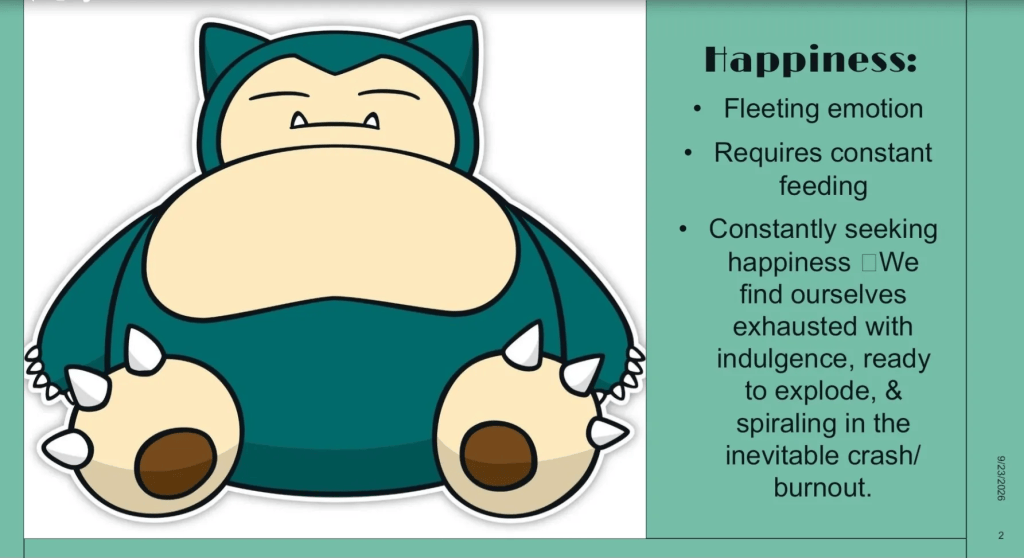
Joy is defined by the dictionary as a “feeling of great happiness.” What a crock. Happiness is a fleeting emotion that requires constant feeding. If you feed something constantly, you ultimately wind up with it exhausted with indulgence, ready to explode, & spiraling in the inevitable crash/burnout! (I love Snorlax, because he’s kind of the perfect picture of that, isn’t he?!?)

Happiness is a feeling that tends to be externally driven. It depends on situations, events, and other people aligning with your expectations. It’s future-oriented: you’ll be happy when you get the job, find the relationship, or reach the goal. Joy is more internal and less dependent on circumstances. It can exist alongside difficulty.”

Joy is a choice; it is a disciplined state that you can maintain even in the midst of pain. Joy is dependent upon the hope we have, that God is eternal and His character is unchanging! Because He remains, Joy can remain.

In the movie Inside Out, Joy & Sadness are partnered up as Sadness tries to take over & Joy feels the need to establish dominance. Joy doesn’t understand that her existence is actually made even brighter by the contrast of Sadness, not darkened when Sadness is near. Sadness and darker times solidify the truth of Joy in our lives; the desolate times make the spark of Joy have even more depth. This is impacted by our willingness to be transparent, as transparency →the acknowledgment of hard times→expressing our pain to God→Watching Him move with us, thru us, and beyond us, to sustain us & see us thru to the other side in His time. 

The Psychology Today article by Dr. Jamie D. Aten, Ph.D., titled, “What is Joy and What Does it Say About Us?” features an interview with Dr. Pamela King. In the interview, she speaks about the actual science of joy, & covers 3 areas that “deeply inform joy:”

  1. Growing in authenticity & living more into one’s strengths
  2. Growing in deep relationships & contributing to others (this is only possible when we’re authentic with ourselves & with others. Transparency again, leads to deep roots!)
  3. Living more aligned with one’s ethical and spiritual ideals

I love that all of the words she chose to describe growing in joy, are -ing words. They’re Being Verbs—BEEEEEEEEEEEING! Human BEEEEEEings! Joy cannot grow from a place of stasis! Stasis = Death. Think about it–nasty, stagnant water is a breeding ground for disease. Yes, it can develop its own ecosystem of decomposition, but nothing there is good. We are made in the image of God as Human BEings by a God Who’s literal Name is I AM. We. Have. To. Exist in a state of action verbs! Our lives, our successes, and our joy requires either action verbs or DEATH. It’s amazing!

So, this small group study I’m writing is titled, “All the Feels: The Facets of Feelings through the Facts of Faith.” This means I want to look at the people in the Bible who went through each emotion, and we’re discussing how they handled it, both good and bad. How can we apply these lessons and processes to our lives? Let’s take a look at a few:

  1. Paul, while in prison & thru so many trials!
    1. Phil. 1:3-6, 18-26
    2. Acts 16:25-34
  2. Mary
    1. Mary’s Song: Luke 1:46-56
    2. Side note: In the same chapter, Elizabeth’s son John “leaped for joy” in the womb when Elizabeth heard Mary’s greeting! Even in the womb, we know true joy, spirit-to-spirit!
  3. David:
    1. Bringing the Ark of the Covenant to Jerusalem: In 2 Samuel 6:14-22, 
    2. I Chronicles 29:9-16
    3. So many Psalms! Psalm 4:7, “You have put more joy in my heart than they have when their grain and wine abound,”

I’m not going to go into each one, because my mom already says my blogs are too long. 🙂 Each of these people, however, had situations where maybe they had a reason to celebrate; maybe they didn’t. Paul was rotting in jail, but he used his time to give thanks to God and holy cow, the testimony he could share from that experience! Mary, as a young teenager, sang praise to God even though His angel just told her she was about to be an unwed mother–a death sentence in her time–and went to visit her aunt, who by all accounts shouldn’t have been able to conceive.

David–I love King David–exemplified the up-&-down journey of our spiritual walk, and by the end of it, showed a lot of transparency (good and bad) in his relationship with God. Never one to mince words; on the occasion referenced above, he was so excited about bringing the Ark back to Jerusalem that he scandalously danced in his underwear through the city (thoroughly angering his wife). His unabashed, joyful worship showed that he had no pretenses whatsoever in how he felt about the Lord….he was willing to be undignified in his joy. When was the last time you were undignified in your joy? What would that look like?

You know, I found something very interesting in working on the topic of joy…Galatians 5:22 lists Joy as a Fruit of the Holy Spirit. Love, JOY, peace, patience, kindness, goodness, faith, gentleness, and self-control…but how is Joy also a feeling, when a feeling is fleeting?

Because it’s not.

Happiness, like I said when I started this, is a feeling. Joy is a choice…a state…a fruit or a byproduct of a close walk with God by the power of the Holy Spirit. The fruits of the Spirit are stable, building us and those around us up, leading to a domino effect of positive spiritual influence, change, and productivity. Feelings, however, are impulsive, leading to undisciplined actions, behaviors, inconsistency, and never-ending self-indulgence.

99.1 Joy FM literally says, “I Choose Joy” as it’s web handle. I love that! We CHOOSE to embrace the fruits and the gifts of the Holy Spirit in our lives, even when the world is telling us to choose drama, noise, anger, etc. When we choose joy and we choose to share joy, we are pouring out a beautiful perfume to everyone that encounters us. It’s that joy that’s contagious, that makes people want to know why we’re different. He Makes Us Different!

Around 181x in the ESV, we find the word “JOY” in the Bible!

  1. 1 Thessalonians 5:16-18: “Rejoice always, pray continually, give thanks in all circumstances; for this is God’s will for you in Christ Jesus.”
  2. Romans 12:12: “Be joyful in hope, patient in affliction, faithful in prayer.”
  3. Psalm 94:19: “When anxiety was great within me, your consolation brought me joy.”
  4. Psalm 95:1: “Come, let us sing for joy to the Lord; let us shout aloud to the Rock of our salvation.”
  5. Isaiah 12:3: “With joy you will draw water from the wells of salvation.”
  6. Romans 5:11: “Not only so, but we also glory in God through our Lord Jesus Christ, through whom we have now received reconciliation.”
  7. Philippians 4:4: “Rejoice in the Lord always. I will say it again: Rejoice!”
  8. Nehemiah 8:10: “The joy of the Lord is your strength.”

Joy is a place of stability for us, because we are anchored in the hope we have in Jesus. Hope is the key word–hope isn’t a fruit of the Spirit, because it is not based on interpersonal relationships. Hope, like faith, is solely dependent on Jesus & His work in our lives. Hope is between Him and us…and because we KNOW HE IS WHO HE SAYS HE IS, we can have long-standing, solid joy in Him that we share with others!

Choose joy today. Make the decision to sit at the feet of Jesus, share your heart–share the good, the bad, and the ugly–and let Him exchange it for the beauty only He can give, as He heals your hurts & exchanges the pains of this world for the Joy that can only come from Him.